
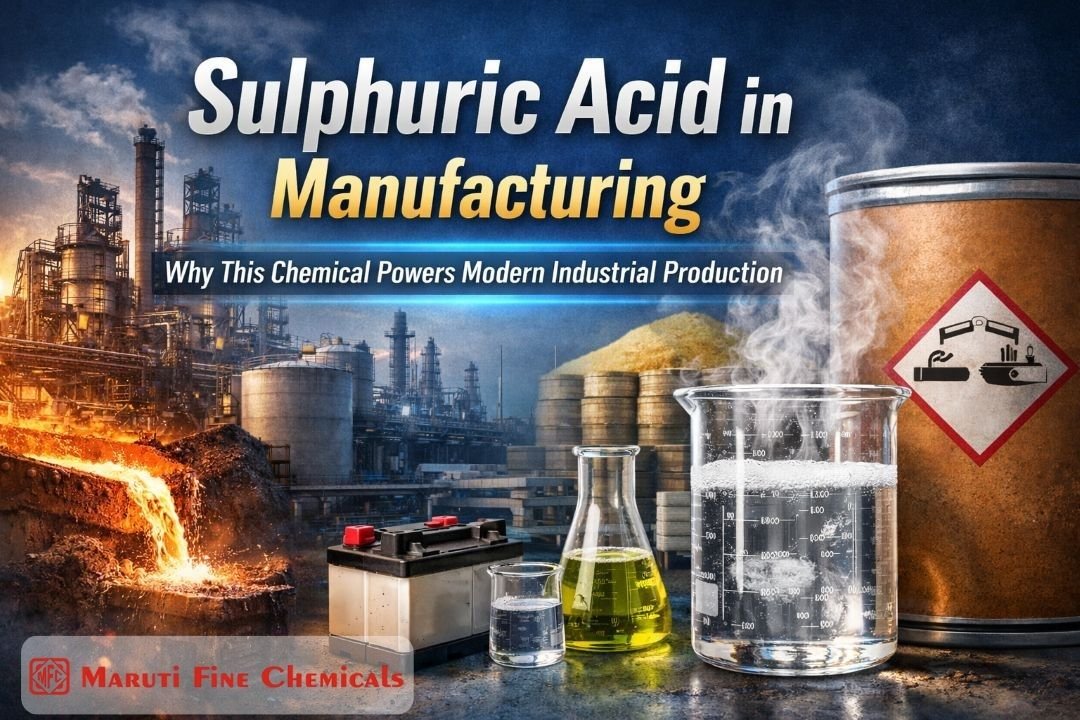
When people talk about essential industrial chemicals, one name quietly dominates the list—sulphuric acid. It may not sound glamorous, but without it, modern manufacturing would slow to a crawl. From fertilizers and metals to batteries and pharmaceuticals, sulphuric acid sits at the center of industrial progress.
This isn’t hype. It’s chemistry-backed reality.
In fact, global industrial output is often measured by sulphuric acid consumption because it directly reflects manufacturing strength. In this blog, we’ll break down why sulphuric acid earns the title of a backbone chemical, how Sulphuric Acid in Manufacturing supports multiple industries, and what businesses should know before sourcing it.
About Us:
Maruti Fine Chemicals is a reliable Indian chemical supplier known for delivering high-quality industrial acids and reagents tailored to manufacturing requirements.
The company supplies essential chemicals including chlorosulfonic acid, fuming nitric acid 98%, hydrochloric acid (35–37%), oleum (fuming sulphuric acid), and sulphuric acid, all manufactured under strict quality control and industry standards. With a strong focus on product consistency, safety, and regulatory compliance, Maruti Fine Chemicals ensures dependable performance across industrial applications.
Supported by a robust supply chain and a customer-focused approach, the company serves manufacturing sectors that require pure, process-ready chemicals for safe and efficient operations.
Industries We Serve:
Maruti Fine Chemicals serves a wide range of industries by supplying high-quality industrial chemicals used in critical manufacturing and processing operations. Its product portfolio includes chlorosulfonic acid, fuming nitric acid 98%, hydrochloric acid (35–37%), oleum (fuming sulphuric acid), and sulphuric acid, all delivered under strict quality and safety standards.
These chemicals are widely used across chemical manufacturing, metal processing, pharmaceuticals, petrochemicals, dyes, and textile industries. By focusing on consistent purity, reliable supply, and technical assistance, the company helps industrial clients achieve efficient production, safety assurance, and regulatory compliance through well-controlled sourcing and quality practices.
What Makes Sulphuric Acid So Important?
Sulphuric acid (H₂SO₄) is one of the most widely produced chemicals in the world—and for good reason. Its importance lies in three core qualities:
- High reactivity
- Strong acidic nature
- Versatility across applications
Unlike specialty chemicals used for a single purpose, sulphuric acid is adaptable. It functions as a raw material, catalyst, dehydrating agent, and processing aid—all rolled into one.
That flexibility makes Sulphuric Acid in Manufacturing indispensable across industries that depend on consistency, scalability, and efficiency.
Sulphuric Acid in Manufacturing: The Core Role
The real power of sulphuric acid lies in how deeply it’s embedded into industrial workflows. It doesn’t just support manufacturing—it enables it.
Here’s how Sulphuric Acid in Manufacturing forms the foundation of large-scale production systems.
- Fertilizer Manufacturing: Feeding the World
Over 60% of sulphuric acid produced globally is used in fertilizer manufacturing. It’s a critical input in producing phosphoric acid, which is then used to make phosphate fertilizers.
Without sulphuric acid:
- Crop yields would drop
- Food prices would rise
- Agricultural supply chains would suffer
This single application shows why sulphuric acid is not optional—it’s structural.
- Metal Processing and Refining
Steel, copper, zinc, and aluminum industries rely heavily on sulphuric acid for:
- Pickling (cleaning metal surfaces)
- Ore leaching
- Removing oxidation and scale
- Improving metal purity
In metal processing, Sulphuric Acid in Manufacturing ensures cleaner surfaces, stronger bonds, and higher-quality outputs—especially in automotive, construction, and infrastructure sectors.
- Petroleum Refining and Chemical Processing
In oil refineries, sulphuric acid is used as a catalyst in alkylation processes to produce high-octane fuel components. It also plays a key role in:
- Removing impurities
- Neutralizing unwanted compounds
- Supporting downstream chemical reactions
Without sulphuric acid, refining efficiency drops—and so does fuel quality.
- Battery Manufacturing and Energy Storage
Lead-acid batteries still power vehicles, industrial equipment, and backup power systems worldwide. Sulphuric acid acts as the electrolyte that enables energy storage and release.
As electric vehicles and energy storage systems grow, Sulphuric Acid in Manufacturing continues to support both traditional and transitional energy technologies.
- Pharmaceuticals and Fine Chemicals
Sulphuric acid is used in synthesizing active pharmaceutical ingredients (APIs), intermediates, and laboratory-grade compounds. Its role includes:
- pH control
- Catalysis
- Reaction acceleration
- Compound stabilization
Precision matters here, and high-purity sulphuric acid ensures consistent results in regulated environments.
Why Manufacturers Depend on Sulphuric Acid?
The reason sulphuric acid remains irreplaceable comes down to five practical advantages:
- Cost Efficiency at Scale
It delivers strong performance without high production costs.
- Chemical Stability
It performs reliably under extreme temperatures and pressures.
- Process Compatibility
It integrates easily into existing manufacturing systems.
- Multi-Industry Applicability
Few chemicals serve as many sectors as sulphuric acid does.
- Proven Industrial Track Record
Decades of industrial usage make it trusted and predictable.
This is why Sulphuric Acid in Manufacturing continues to be a long-term staple, not a temporary solution.
Environmental and Safety Considerations:
Let’s be clear—sulphuric acid is powerful, and that power comes with responsibility.
Manufacturers must manage:
- Proper storage systems
- Controlled handling procedures
- Spill prevention and containment
- Waste neutralization protocols
When handled correctly, sulphuric acid is safe, efficient, and environmentally manageable. Modern manufacturing plants use closed-loop systems and emission controls to minimize risk.
Responsible sourcing and compliance are non-negotiable here.
Quality Matters: Not All Sulphuric Acid Is the Same
Industrial outcomes depend heavily on acid concentration, purity, and consistency. Impurities can lead to:
- Equipment corrosion
- Inconsistent reactions
- Product defects
- Higher operational costs
This is why manufacturers partner with experienced chemical suppliers who understand industrial-grade requirements.
Companies like Maruti Fine Chemicals focus on delivering consistent-quality sulphuric acid tailored for manufacturing needs, ensuring smooth integration into production workflows without performance surprises.
How Sulphuric Acid Impacts Industrial Growth?
There’s a reason economists track sulphuric acid output—it’s a direct indicator of industrial expansion.
When manufacturing grows:
- Demand for sulphuric acid rises
- Infrastructure investment increases
- Chemical supply chains strengthen
From small-scale plants to large industrial hubs, Sulphuric Acid in Manufacturing mirrors economic momentum.
Future Outlook: Will Sulphuric Acid Stay Relevant?
Short answer—yes.
Despite advances in green chemistry, no alternative currently matches sulphuric acid’s combination of:
- Strength
- Versatility
- Cost-effectiveness
- Industrial familiarity
While processes are becoming cleaner and more efficient, sulphuric acid remains central to modern manufacturing and will continue to evolve alongside sustainability initiatives.
Choosing the Right Supplier for Sulphuric Acid:
If sulphuric acid is critical to your production, supplier selection matters more than price alone. Look for:
- Consistent batch quality
- Compliance with safety standards
- Reliable logistics
- Technical support
Working with established manufacturers like Maruti Fine Chemicals helps ensure your supply chain stays stable, compliant, and production-ready.
Frequently Asked Questions (FAQs):
What is sulphuric acid mainly used for in manufacturing?
Sulphuric acid is used in fertilizer production, metal processing, petroleum refining, battery manufacturing, and chemical synthesis.
Why is sulphuric acid called a backbone chemical?
Because it supports a wide range of industries and processes that form the foundation of modern manufacturing.
Is sulphuric acid used directly in finished products?
In some cases yes (like batteries), but often it’s used as a processing or intermediate chemical.
How does sulphuric acid affect manufacturing efficiency?
It improves reaction speed, product quality, material purity, and overall process reliability.
Is sulphuric acid environmentally safe?
When handled correctly and disposed of responsibly, it can be used safely in industrial environments.
What concentration of sulphuric acid is used in manufacturing?
It varies by application—common concentrations range from dilute solutions to highly concentrated industrial grades.
Final Thoughts:
Sulphuric acid doesn’t grab headlines, but it holds manufacturing together behind the scenes. Its unmatched versatility, reliability, and industrial relevance explain why it remains one of the most produced chemicals on the planet.
If your operations depend on efficiency, scale, and consistent quality, understanding the role of Sulphuric Acid in Manufacturing isn’t optional—it’s essential.
If you are looking for a dependable sulphuric acid supply for your manufacturing needs, get in touch with a trusted chemical partner today and keep your production moving without disruption.
